All dogs form attachments.
Bonding with humans is part of what makes dogs who they are. Over thousands of years, dogs have evolved alongside us, learning to read our cues, respond to our emotions, and rely on us for safety and companionship.
So attachment itself is not unique to small dogs.
What can feel different, however, is how attachment shows up in their daily lives.
For many small dogs, attachment is not only emotional — it is physical, environmental, and shaped by scale.
Attachment Is a Normal and Healthy Response
Attachment is not a flaw. It is not dependency. It is not weakness.
In dogs, attachment serves a practical purpose. Staying close to a trusted person offers safety, predictability, and emotional regulation. It helps a dog interpret unfamiliar situations and recover from stress.
Large dogs form these bonds too. They lean against us, follow us between rooms, rest nearby, and look to us for reassurance.
Small dogs do the same.
But because of their size and proximity, their attachment can look more intense — even when it isn’t.
Living in Close Proximity Changes Things
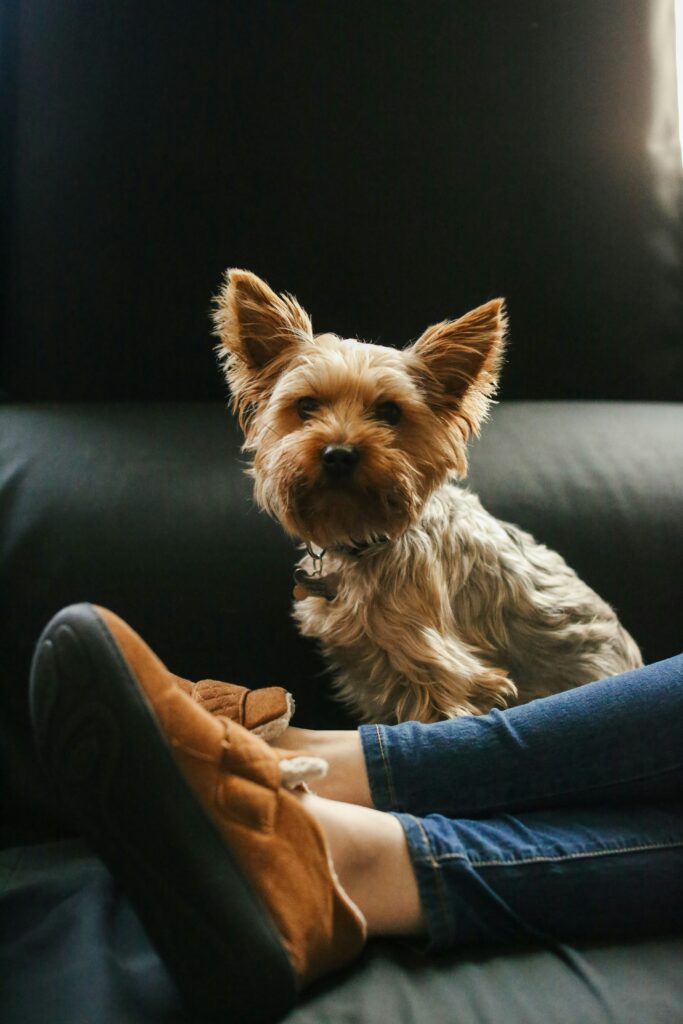
Small dogs are often physically closer to humans throughout the day.
They:
- sit on laps
- sleep on beds
- are carried in unfamiliar spaces
- travel in bags or carriers
- move easily between rooms
This physical closeness reinforces emotional closeness.
When a dog spends more time within arm’s reach, attachment becomes visible in small, continuous ways — eye contact, body contact, following movements.
What might be unnoticed in a larger dog becomes obvious in a smaller one.
Scale and Vulnerability Matter
Size shapes experience.
Small dogs move through a world where:
- people tower above them
- feet pass close by
- unfamiliar dogs feel much larger
- everyday environments can feel overwhelming
Attachment becomes a stabilising force in that environment.
Staying close to a trusted human offers orientation. It helps the dog assess whether something is safe or not. It reduces the need for constant scanning.
What may be interpreted as clinginess is often a form of self-regulation.
Human Behavior Plays a Role
The way we interact with small dogs also influences attachment.
Because they are easy to lift and hold, small dogs are often:
- picked up quickly
- comforted immediately
- kept physically close
- shielded from unfamiliar situations
These behaviours are usually well-intentioned. They come from care.
But they can reinforce a pattern where the dog learns that proximity equals safety, and distance equals uncertainty.
This isn’t inherently negative. It simply shapes how attachment develops.
Why Attachment Can Be Misunderstood
Small dogs are frequently described as “clingy” or “overly attached.”
But attachment only becomes a problem when it prevents a dog from coping with short periods of independence.
Healthy attachment looks like:
- choosing to rest near you
- seeking reassurance when uncertain
- returning to you after exploring
- relaxing in your presence
Unhealthy attachment tends to involve:
- panic when separated
- inability to settle alone
- distress that escalates quickly
The difference isn’t in how much the dog loves you. It’s in how secure they feel when alone.
Supporting Secure Attachment
For small dogs, secure attachment develops when closeness is paired with confidence.
That can look like:
- encouraging short, calm periods of independence
- allowing exploration without immediate intervention
- maintaining predictable routines
- responding consistently rather than urgently
Secure attachment doesn’t weaken the bond. It strengthens it.
A small dog who feels safe both with you and without you is not less attached. They are more secure.
A Matter of Perspective
When we shift our perspective, small dogs begin to make more sense.
Their attachment isn’t excessive. It is shaped by:
- proximity
- vulnerability
- daily interaction patterns
- and the environments we create
Understanding this helps us move away from labels and toward empathy.
Small dogs don’t attach more deeply than other dogs. But because of their size and closeness, we see that attachment more clearly.
And when that attachment is nurtured with steadiness and patience, it becomes one of the most grounding parts of living with a toy dog.